TADAUK.ORG
LEGAL DEPARTMENT EDITORIAL COMMENT
04/02/2026
Tigray Advocacy for Democracy and Accountability- Team (TADAUK)
Date: February 4, 2026
The February 3rd parliamentary address by Prime Minister Abiy Ahmed represents a profound and cynical moment in the history of the Tigray genocide. His attempt to shift blame exclusively to Eritrea for specific atrocities in Shire, Axum, and Adigrat, while simultaneously distancing the core conflict from the Red Sea issue, is not a confession but a strategic dissection of culpability. It is a calculated political maneuver designed to externalize guilt, absolve his regime, and rewrite history. A robust legal analysis exposes this as an admission by omission, a continuation of lies, and grounds for prosecution under both Ethiopian and international law.
I. Admission by Omission and the Architecture of Genocide
Prime Minister Abiy’s speech constitutes a de facto admission of the fact of the atrocities—the destruction, mass killings, and looting—while fraudulently denying the context and his central role. By acknowledging these crimes as the “reason for disagreement with Eritrea,” he implicitly confirms their occurrence, a fact his regime has long obfuscated or denied. This is legally significant as it provides a form of official recognition of the underlying criminal acts.
However, this is where the lie and the blame game become evident. To claim that Eritrea acted unilaterally or outside a joint command structure is contradicted by overwhelming evidence from human rights investigators, media, and the Ethiopian Human Rights Commission (EHRC)/UN OHCHR joint investigation. The November 2020-2022 war was initiated by a coordinated assault by the Ethiopian National Defense Force (ENDF), the Eritrean Defense Forces (EDF), and regional militias on Tigray. Abiy Ahmed, as Commander-in-Chief and head of government, was the principal architect of this coalition. His government invited Eritrean forces into Ethiopian territory, and they operated under a joint strategic objective: the destruction of the Tigray People’s Liberation Front (TPLF) and, by evidence of their actions, the civilian population that sustained it.
Under Ethiopian law, specifically Article 248 of the Ethiopian Criminal Code on “Treason,” whoever, with intent to undermine the sovereignty, constitutional order, or territorial integrity of the state, wages war against the state or allies with a foreign government to that end is guilty of treason. Abiy Ahmed’s alliance with Eritrea to wage war inside Ethiopia against a region of the country constitutes a prima facie case of treason. By ceding Ethiopian sovereignty over Tigray to a foreign army for the purpose of collective punishment, he betrayed the nation he swore to protect.
II. Severity of Crimes Under International Law: Beyond “Disagreement”
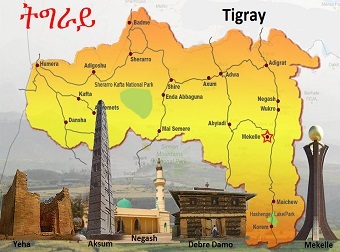
To frame the systematic extermination, rape, and siege as a “disagreement” is a grotesque minimization of crimes against humanity and genocide. The atrocities in Shire (destruction of civilian infrastructure), Axum (the massacre of hundreds), and Adigrat (industrial looting) are not isolated incidents but emblematic of a widespread and systematic attack against the civilian population of Tigray.
1. Crimes Against Humanity: The documented patterns of murder, imprisonment, rape, and persecution meet the threshold of crimes against humanity under the Rome Statute of the International Criminal Court (ICC), Article 7. The siege tactics—the weaponization of humanitarian aid, the blockade of banking, telecom, and fuel—constitute the crime against humanity of “extermination” and “other inhumane acts intentionally causing great suffering.”
2. Genocide: The evidence strongly suggests genocide, under Article 6 of the Rome Statute. The requisite dolus specialis (specific intent to destroy, in whole or in part, a national, ethnic, racial, or religious group) can be inferred from the totality of actions: the inflammatory dehumanizing rhetoric by federal and allied officials, the targeted destruction of livelihood-supporting infrastructure (farmlands, seeds, clinics, factories), the systematic rape of Tigrayan women to destroy the social fabric, and the blockade aimed at causing physical destruction. The estimated 1,000,000 civilian deaths primarily from starvation, 154000 recorded SGBV cases and denied medical care, are a direct consequence of this genocidal strategy orchestrated from Addis Ababa.
Abiy’s speech attempts to surgically excise Eritrea’s role to scapegoat President Isaias Afwerki, but under the principle of joint criminal enterprise (JCE) and command responsibility, both leaders are jointly liable. As the architect, Abiy bears superior responsibility for all foreseeable acts of his allies.
III. Sentencing Considerations and Jurisdictional Pathways
The sentencing for crimes of this magnitude is unequivocal. Under international sentencing guidelines for genocide and crimes against humanity, life imprisonment is the standard maximum penalty. Given the scale—approximately 1,000,000 deaths, widespread sexual violence, and the catastrophic destruction of a region—a term of life imprisonment, reflecting the utmost gravity, would be legally and morally warranted. Aggravating factors include the abuse of supreme authority, the multiplicity of victims, and the particular cruelty of imposing a famine.
The critical question is which court should oversee this case. Several pathways exist:
1. Ethiopian Federal Courts: This is the first port of call under the principle of complementarity. However, the current judiciary lacks independence and is under the influence of the accused’s regime. A credible prosecution is impossible without a fundamental political transition.
2. International Criminal Court (ICC): Ethiopia is not a state party to the Rome Statute. The UN Security Council could refer the situation, but geopolitical interests have historically blocked such action. An alternative is for a future, legitimate Ethiopian government to accept ICC jurisdiction ad hoc.
3. A Special International or Hybrid Tribunal: This is the most viable and just solution. Following models like the International Criminal Tribunal for the former Yugoslavia (ICTY) or the Extraordinary African Chambers (for Hissène Habré), the international community, led by the African Union and supported by the UN, should establish a Special Tribunal for Tigray (STT). This court would have jurisdiction over crimes committed in Tigray by all parties (ENDF, EDF, Amhara forces, TPLF) between 2020-2023. Its hybrid nature, blending international and Ethiopian law and jurists, would ensure legitimacy, expertise, and a sense of local ownership.
IV. TADAUK Editorial Conclusion
Abiy Ahmed’s speech is not a step toward accountability; it is a desperate act of historical revisionism. By admitting the crime scene but blaming only the accomplice, he reveals his understanding of the mounting legal peril. The “disagreement” is not with Eritrea about the facts; it is with the people of Tigray and the international conscience about impunity.
The legal path is clear. The crimes of treason under Ethiopian law and genocide under international law are documented. The architect must be indicted. We call for:
· The immediate establishment of an independent, UN-backed investigation to consolidate evidence.
· The formation of a Special Tribunal for Tigray by the African Union and United Nations.
· The surrender of all suspects, including Prime Minister Abiy Ahmed and President Isaias Afwerki, to face justice.
Five years of denial have compounded the atrocity. Justice delayed is justice denied. The international community must move beyond statements of concern to concrete action. The victims in Tigray , Amhara and Oromia and every decimated village demand nothing less than a full legal reckoning in a competent court of law. The sentence must match the crime, and the court must be free from the architect’s influence. Only then can the long road to healing begin.
TADAUK Legal Department
For Truth, Accountability, and Justice.